The startup ecosystem across Gujarat is growing rapidly. Cities like Ahmedabad, Surat, Vadodara, and Rajkot are seeing a rise in technology companies, manufacturers, exporters, agencies, healthcare ventures, educational startups, and service-based businesses. While building a company has become easier than ever, one challenge remains constant: creating a professional online presence that helps attract customers and generate revenue.
In 2026, startup founders have two major options. They can build their website using WordPress, the world’s most widely used content management system, or they can choose a No-Code platform such as Webflow, Wix, Squarespace, Framer, or Bubble. Both approaches promise fast website creation, professional design, and business growth. The real question is whether these promises hold up when a startup begins scaling.
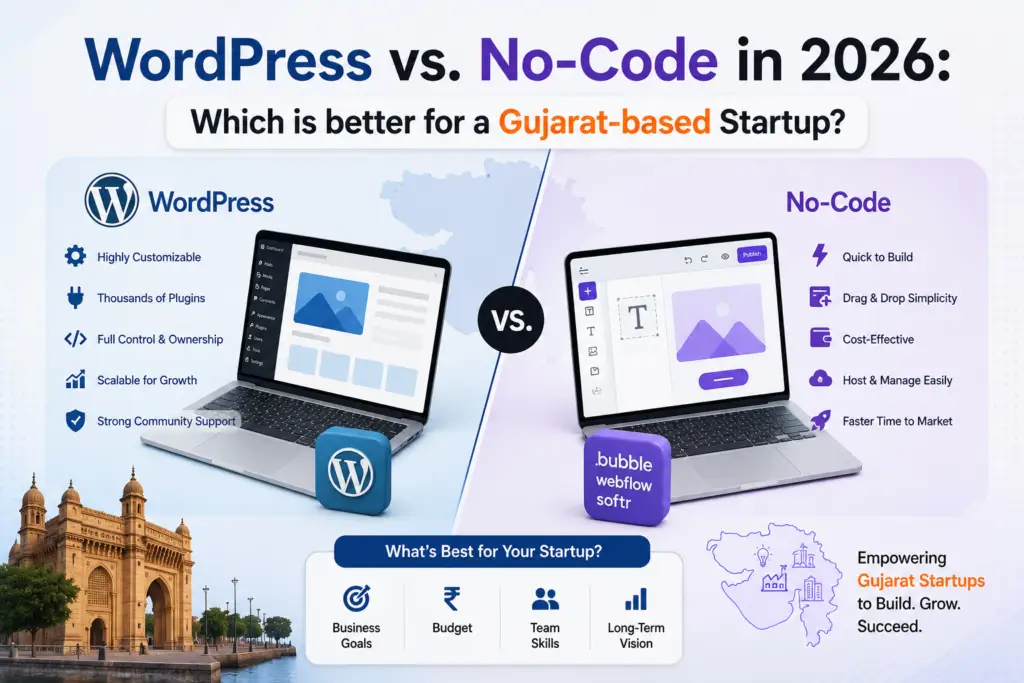
Many founders are tempted by no-code solutions because they appear quick and simple. Others prefer WordPress because of its flexibility and massive ecosystem. The decision is not simply about creating a website; it is about choosing the digital foundation that will support your business over the next five years. The right choice can reduce costs, improve SEO performance, and make expansion easier. The wrong choice can lead to migration headaches, higher monthly expenses, and limited growth opportunities.
This guide explores both options from the perspective of a Gujarat-based startup looking to compete in local, national, and global markets.
The Digital Transformation of Gujarat Startups
Gujarat has long been known for entrepreneurship. From textile manufacturers and exporters to technology companies and service providers, business owners in the state are increasingly investing in digital channels to generate leads and sales. Customers now search online before making purchasing decisions. A startup without a professional website often appears less credible compared to competitors with a strong digital presence.
The rise of AI-powered search, local SEO, and mobile-first browsing has changed how businesses attract customers. A startup website is no longer just a digital brochure. It has become a sales tool, marketing platform, customer support center, and brand-building asset. Whether a company serves local customers in Gujarat or international clients, the website often becomes the first point of interaction.
This shift is why choosing between WordPress and No-Code platforms matters more than ever. The platform determines how easily you can rank on search engines, manage content, add new features, and scale operations. What works for a small startup today may become a limitation tomorrow. Smart founders think beyond launch day and evaluate long-term business impact before selecting a platform.
Why Every Startup Needs a Strong Online Presence
Customers expect businesses to be available online 24/7. A professionally built website increases trust, improves visibility, and helps convert visitors into customers. Startups that invest in digital assets early often gain a competitive advantage because they can build authority and organic traffic before competitors catch up.
For Gujarat-based startups targeting industries like manufacturing, education, healthcare, real estate, exports, or IT services, a website also helps establish credibility in international markets. Many overseas buyers research suppliers online before initiating contact. A weak website can result in missed opportunities regardless of how good the underlying business may be.
Understanding WordPress in 2026
WordPress has been the dominant website platform for years, and it remains a major force in 2026. Recent industry statistics show WordPress powers approximately 42–43% of all websites globally and nearly 60% of websites using a content management system.
What Makes WordPress Different
Unlike proprietary website builders, WordPress is open-source software. This means business owners own their website, data, and hosting environment. They are not locked into a single provider. If a startup wants to move to another hosting company, redesign its website, or add custom functionality, it can do so without rebuilding everything from scratch.
WordPress offers thousands of themes, plugins, and integrations. Whether you need a blog, company website, online store, membership portal, booking system, or learning platform, there is usually a solution available. This flexibility is one of the biggest reasons businesses continue choosing WordPress despite increasing competition from no-code tools.
The platform also benefits from a huge global developer community. Finding WordPress professionals in Gujarat is relatively easy compared to hiring specialists for certain niche no-code platforms. This availability often reduces development costs and ensures long-term support.
Latest WordPress Market Share Statistics
Industry data published during 2026 shows WordPress still powers over 42% of all websites and maintains roughly 60% CMS market share despite growing competition from website builders and no-code platforms.
This market dominance matters because it creates a large ecosystem of developers, plugins, themes, educational resources, and integrations. When a startup chooses WordPress, it joins an ecosystem that has matured over more than two decades. That maturity often translates into lower risk and greater flexibility compared to newer alternatives.
Understanding No-Code Platforms
No-code platforms have evolved significantly in recent years. They allow users to build websites and applications through visual interfaces rather than traditional programming. This approach makes website creation accessible to founders without technical skills.
What No-Code Means in 2026
Modern no-code tools focus on simplicity. Instead of installing plugins, configuring servers, or writing custom code, users drag and drop elements into place. Hosting, updates, and maintenance are typically handled by the platform provider.
For startups with limited technical resources, this simplicity can be attractive. A founder can launch a professional-looking website within days rather than weeks. This speed is particularly valuable during early-stage validation when businesses need to test ideas quickly.
The downside is that simplicity often comes at the cost of flexibility. As businesses grow, they may encounter limitations related to customization, integrations, or platform-specific restrictions. What feels convenient initially can become restrictive later.
Popular No-Code Platforms Used by Startups
Several no-code platforms dominate the market in 2026. Each has different strengths and target audiences.
| Platform | Best For | Limitation |
|---|---|---|
| Webflow | Design-focused websites | Learning curve |
| Wix | Small business websites | Limited scalability |
| Squarespace | Simple professional sites | Less customization |
| Bubble | Web applications | Complex projects require expertise |
| Framer | Landing pages | Limited advanced functionality |
While these tools can produce impressive results, startups must evaluate whether the platform can support future business requirements rather than focusing solely on launch speed.
Cost Comparison for Gujarat-Based Businesses
Cost remains one of the biggest deciding factors for startups operating with limited budgets.
Initial Development Costs
No-code platforms often appear cheaper at first glance. Monthly subscription plans typically include hosting, templates, and support. A founder can launch without hiring a developer.
WordPress may require domain registration, hosting, premium themes, and occasional development assistance. This can make the initial setup seem more expensive. However, the difference is often smaller than many entrepreneurs assume.
For startups working with local WordPress professionals in Gujarat, development costs remain relatively affordable compared to international rates. This accessibility makes WordPress a practical option even for budget-conscious founders.
Long-Term Ownership Costs
The cost equation changes over time.
No-code platforms charge recurring monthly fees that increase as traffic, features, and storage requirements grow. A startup experiencing rapid growth may find itself paying significantly more each year.
WordPress generally offers lower long-term ownership costs because businesses can choose their hosting provider and scale infrastructure according to actual needs. Rather than paying platform fees indefinitely, companies maintain greater control over expenses.
For startups planning long-term growth, ownership economics often favor WordPress.
Speed of Launch
When No-Code Wins
No-code platforms excel when speed is the highest priority. A founder can create landing pages, test products, and validate ideas within days. This makes them useful during early startup experimentation.
If the goal is simply to establish an online presence and gather initial feedback, no-code solutions offer a compelling advantage. Teams can focus on marketing and sales rather than technical implementation.
When WordPress Wins
WordPress can also support rapid deployment thanks to modern themes, page builders, and pre-built templates. While setup may require slightly more effort, the difference is often measured in days rather than months.
The advantage emerges after launch. WordPress websites are easier to expand with advanced functionality, making them more suitable for startups expecting significant growth. What takes slightly longer initially may save substantial time and money later.
SEO Performance Comparison
Organic Traffic Potential
SEO remains one of the strongest arguments in favor of WordPress.
Many successful content-driven businesses use WordPress because of its extensive SEO capabilities. Advanced plugins, customizable URL structures, schema markup, content management features, and technical optimization tools provide significant control over search visibility.
No-code platforms have improved their SEO features, but they often offer less flexibility. Startups targeting competitive keywords may eventually encounter limitations that make advanced optimization more difficult.
For businesses relying heavily on organic traffic, WordPress usually provides a stronger foundation.
Local SEO for Gujarat Businesses
Local SEO is particularly important for startups targeting customers in Gujarat. Businesses need location-specific landing pages, blog content, structured data, and citation management.
WordPress makes these tasks easier through specialized SEO plugins and local optimization tools. Whether targeting customers in Ahmedabad, Surat, Vadodara, Rajkot, or other cities, businesses can build highly optimized content structures that support long-term search growth.
This advantage becomes especially valuable for service providers, agencies, consultants, manufacturers, and exporters seeking qualified leads.
Scalability and Future Growth
Growing From Startup to Established Brand
Many founders choose platforms based on current requirements rather than future needs. This approach often creates problems.
A startup may begin with a simple five-page website. Within two years, it might require eCommerce functionality, CRM integrations, multilingual support, customer portals, or advanced marketing automation. WordPress handles these transitions relatively smoothly.
No-code platforms can support growth to a certain extent, but complex requirements often expose platform limitations. Businesses sometimes need complete migrations once they outgrow their original solution.
The cost and disruption of migration can exceed the savings gained from choosing a no-code platform initially.
Customization and Flexibility
Customization is where WordPress clearly separates itself from most no-code solutions.
Every startup is unique. Some require specialized workflows, custom integrations, or industry-specific features. WordPress enables virtually unlimited customization because developers can modify both frontend and backend functionality.
No-code platforms typically operate within predefined boundaries. While they allow substantial design flexibility, deep customization may not always be possible. Startups with ambitious long-term plans should carefully evaluate whether platform limitations could affect future growth.
Business requirements rarely become simpler over time. They usually become more complex. A platform that supports complexity often delivers greater value in the long run.
Security and Maintenance
Security is a critical consideration for any business website.
No-code platforms manage updates, infrastructure, and security patches automatically. This reduces administrative responsibility and lowers the risk of user error.
WordPress requires active maintenance. Themes, plugins, and core software must be updated regularly. Security vulnerabilities can arise when websites are neglected. Industry reports continue to show plugin-related vulnerabilities as a common security concern, making proper maintenance essential.
Despite this, well-maintained WordPress websites can achieve excellent security standards. Many businesses prefer this approach because it provides greater control over infrastructure and security policies.
Real-World Startup Scenarios
Manufacturing Startup
A manufacturing company in Gujarat typically needs product catalogs, inquiry forms, SEO content, multilingual support, and lead generation capabilities. WordPress is usually the stronger choice because it supports long-term content marketing and international expansion.
SaaS Startup
A SaaS startup validating a new product may benefit from a no-code landing page during early stages. Once growth accelerates, WordPress often becomes valuable for content marketing, SEO, and customer acquisition efforts.
Local Service Business
Service providers such as consultants, agencies, healthcare clinics, or educational institutions generally benefit from WordPress due to superior SEO flexibility and local search optimization opportunities.
Final Verdict for Gujarat Entrepreneurs
The best platform depends on business goals.
If your startup needs a quick launch, minimal maintenance, and a simple online presence, a no-code platform can be a practical solution. It allows rapid deployment and reduces technical complexity.
If your startup plans to invest in SEO, content marketing, long-term scalability, and business growth, WordPress remains the stronger option. The platform’s flexibility, ownership model, extensive ecosystem, and proven track record continue to make it a preferred choice for ambitious businesses. While WordPress has seen slight market-share fluctuations, it still powers over 42% of websites globally and remains the dominant CMS ecosystem.
For most Gujarat-based startups focused on sustainable growth rather than short-term convenience, WordPress delivers greater long-term value.
Conclusion
The WordPress versus No-Code debate is not about which platform is universally better. It is about selecting the right tool for your startup’s stage, goals, and growth plans.
No-code platforms excel at speed, simplicity, and ease of use. They help founders validate ideas quickly without technical expertise. WordPress excels in flexibility, SEO performance, ownership, scalability, and long-term business growth.
For Gujarat entrepreneurs building serious brands, generating leads through search engines, and planning for expansion, WordPress remains one of the strongest investments available in 2026. The platform’s maturity, ecosystem, and customization capabilities continue to provide advantages that many no-code alternatives struggle to match.
FAQs
1. Is WordPress still relevant in 2026?
Yes. WordPress still powers more than 42% of websites globally and remains the leading content management system.
2. Are no-code platforms better for beginners?
Yes. Most no-code platforms are easier for beginners because they require little or no technical knowledge.
3. Which option is cheaper for startups?
No-code platforms may be cheaper initially, but WordPress often becomes more cost-effective over the long term due to lower ownership costs and greater flexibility.
4. Which platform is better for SEO?
WordPress generally provides stronger SEO capabilities, especially for businesses relying on content marketing and organic traffic growth.
5. What should a Gujarat-based startup choose?
If long-term growth, SEO, and customization are priorities, WordPress is usually the better choice. If rapid launch and simplicity matter most, a no-code platform may be sufficient.