🤖 What This Checklist Covers
Search is changing faster in 2026 than it has in the last 10 years combined. Google’s AI Overviews now answer questions directly without users clicking websites. ChatGPT has a search feature. Perplexity AI is being used for product research. Voice search is growing rapidly. The businesses that adapt their websites now will dominate search results for the next decade. Those that don’t will quietly disappear from visibility — even if their SEO was perfect in 2024. This checklist covers exactly what to change, add, and optimize — in practical, actionable steps.
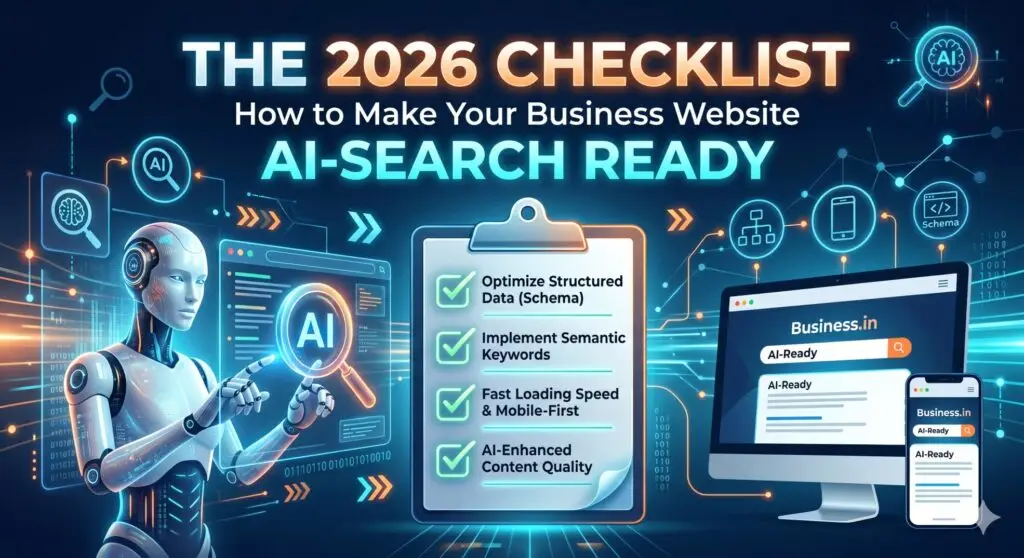
📋 The Complete AI-Search Checklist — 10 Areas
- Understanding AI search — what changed and why it matters
- E-E-A-T signals — proving your expertise to AI
- Conversational content — writing how people actually ask
- Structured data — speaking AI’s language
- FAQ and Q&A content — the AI magnet
- Page speed and core web vitals — non-negotiable
- Local AI search — for Gujarat businesses specifically
- Content depth and topical authority
- Voice search optimization
- Entity SEO — becoming a known entity to AI
Something happened quietly in early 2026 that changed business websites forever.
A restaurant owner in Rajkot noticed that his Google traffic dropped by 30% — despite his website rankings staying exactly the same. A coaching center in Surat saw the same. A doctor’s clinic in Ahmedabad. A hardware store in Bhavnagar.
Same rankings. Less traffic. Why?
Google’s AI Overviews. The feature that answers search queries directly at the top of the page — before the user sees any website links. Users get their answer. They don’t click. Your traffic disappears. Even if you’re ranking number 1.
But here is the flip side — and this is the opportunity most people are missing:
Websites that are properly optimized for AI search are getting MORE visibility, not less. They are being cited in AI Overviews. They are being referenced by ChatGPT when users ask questions. They appear in Perplexity AI results. They answer voice searches. The same shift that is hurting unprepared websites is creating massive opportunities for prepared ones.
“In 2026, the question is no longer ‘does Google rank my website.’ The question is ‘does AI trust my website enough to cite it as a source.’ That is a fundamentally different challenge — and a fundamentally different opportunity.”
58%
of Google searches in 2026 now trigger AI Overviews — up from 12% in 2024
3x
more likely to be cited in AI results if your website has proper structured data
40%
of consumers now use AI assistants (ChatGPT, Gemini, Perplexity) for product and service research
1. Understanding AI Search — What Changed and Why It Matters
Before the checklist — a clear picture of what AI search actually means for your business website in 2026.
The Three AI Search Platforms That Affect Your Website
🔵
Google AI Overviews
Appears at top of Google search results. Summarizes answers from multiple websites. If your website is cited — massive visibility. If not cited — reduced click-through even if ranking high.
🟢
ChatGPT Search
ChatGPT now searches the web for current information. Users ask “best web designer in Gujarat” and ChatGPT returns results from indexed websites. Your website can appear here.
🟣
Perplexity AI
AI-powered search engine growing rapidly in India. Used heavily for research and product comparisons. Cites sources with links — high-quality citation opportunity for businesses.
Old SEO vs AI-Ready SEO — The Key Differences
| Dimension | Old SEO (2020-2024) | AI-Ready SEO (2026) |
|---|---|---|
| Primary goal | Rank on page 1 of Google | Be cited by AI as a trusted source |
| Content style | Keyword-optimized paragraphs | Conversational, question-answering, factual |
| Content depth | Longer = better (word count focused) | More accurate, more specific, more trustworthy |
| Authority signals | Backlinks and domain authority | E-E-A-T — real expertise, real experience |
| Technical focus | Title tags, meta descriptions | Structured data, schema markup, entity signals |
| Content format | Long-form articles with H2 headings | FAQ sections, direct answers, concise explanations |
| Local signals | NAP consistency, local keywords | All of that + verified entity, local expertise demonstration |
💡 The Core Shift: Old SEO optimized for an algorithm that read keywords. AI-ready SEO optimizes for systems that evaluate trustworthiness, expertise, and the genuine helpfulness of your content. The shift is from “what does this page contain” to “should AI recommend this page as a reliable source.”
CRITICAL
2 E-E-A-T Signals — Proving Your Expertise to AI
E-E-A-T stands for Experience, Expertise, Authoritativeness, and Trustworthiness. Google introduced it years ago — but in 2026 it has become the single most important factor for AI search visibility. AI systems are fundamentally trying to answer one question about your website: should I trust this source enough to cite it?
E-E-A-T is how you prove the answer is yes.
🔴 Low E-E-A-T Website (AI Ignores)
- No author name on articles
- No About page with real credentials
- Generic content with no real expertise
- No contact information visible
- No reviews or testimonials
- No real photos of team or workplace
- Content could have been written by anyone
🟢 High E-E-A-T Website (AI Cites)
- Named author with credentials on every post
- Detailed About page — real person, real background
- Content demonstrates genuine firsthand experience
- Multiple contact methods clearly visible
- Real customer reviews embedded or linked
- Real photos — team, workspace, work samples
- Only an expert in this field could write this
- Every blog post has a named author with a short bio and photo
- About page shows real person — name, photo, years of experience, specific credentials
- Contact page has phone, email, address, and WhatsApp — not just a form
- Real photos throughout — not stock images
- Google reviews linked or embedded on website
- LinkedIn profile linked from About page
- Privacy Policy and Terms page exist
- Business address matches Google Business Profile exactly
- SSL certificate active (https)
- Website updated recently — no content older than 2 years without refresh
📌 Why E-E-A-T Matters More Than Keywords Now
A Surat interior designer had a perfectly keyword-optimized website — but zero author information, stock photos throughout, and an About page that said “we are a team of professionals.” When Google’s AI Overview started answering “best interior designer Surat” queries — it cited a competitor whose website had a named designer, real project photos, a detailed personal story, and genuine client reviews. Same keywords. Completely different trust signals. AI chose the one it could verify as a real expert.
EASY WINS
3 Conversational Content — Writing How People Actually Ask
AI search systems process natural language — the way people actually speak and type questions. Traditional SEO content was written for keyword algorithms. AI-ready content is written for how humans naturally ask questions.
The shift is subtle but significant. Instead of writing “affordable website design services Gujarat” — you write content that answers “how much does a website cost for a small business in Gujarat?” Both contain the same topic — but one is written for a 2019 keyword algorithm and one is written for a 2026 AI system.
Conversational Content Examples
| Old Style (Keyword Focused) | AI-Ready Style (Conversational) |
|---|---|
| “Professional website design services for small businesses in Gujarat at affordable prices” | “How much does a website cost for a small business in Gujarat? Most small business websites in Gujarat cost between ₹5,999 and ₹15,000 depending on the number of pages…” |
| “Google Maps optimization services Rajkot” | “How do I get my Rajkot business to appear on Google Maps? First, you need to claim your Google Business Profile at business.google.com…” |
| “Best ceramic tile exporter Morbi Gujarat” | “What makes a reliable ceramic tile manufacturer in Morbi? When evaluating Morbi tile suppliers, buyers should look for ISO certification, minimum 5 years of export experience…” |
- Every service page answers “what is,” “how does,” “why should I” questions naturally
- Use complete sentences that answer questions directly — not keyword fragments
- Include the exact questions your customers ask — in the content itself
- Write at a 7th-grade reading level — clear, simple, direct
- Avoid industry jargon without explanation
- Use “you” and “your” frequently — conversational tone
- Include specific numbers, prices, timelines — AI prefers specific facts over vague claims
🎯 Conversational Content Test: Read your web page content out loud. Does it sound like something a knowledgeable person would actually say to a customer? Or does it sound like someone stuffing keywords into sentences? If it sounds unnatural spoken aloud — rewrite it. AI systems process language the same way humans process speech.
MEDIUM
4 Structured Data — Speaking AI’s Language
Structured data (also called schema markup) is code you add to your website that explicitly tells AI and search engines what your content means — not just what it says. It is the difference between an AI guessing that you are a local business and an AI knowing with certainty that you are a specific type of business at a specific location with specific services.
In 2026, structured data is one of the clearest signals that gets websites cited in AI Overviews and AI search results. It is not optional anymore for any business serious about AI-search visibility.
Essential Schema Types for Business Websites in 2026
| Schema Type | What It Tells AI | Priority |
|---|---|---|
| LocalBusiness | Your business name, address, phone, hours, service area, price range | 🔴 Critical |
| FAQPage | Your Q&A content — AI uses this directly for Featured Snippets and AI Overviews | 🔴 Critical |
| Person | Who the expert behind the website is — name, job title, credentials | 🔴 Critical for E-E-A-T |
| BlogPosting / Article | Author, date published, topic — helps AI evaluate content freshness and authority | 🟡 Important |
| Product | Product name, description, price, availability — for e-commerce and product pages | 🟡 Important for product sites |
| Review / AggregateRating | Customer reviews and star ratings — appears directly in search results | 🟡 High impact |
| BreadcrumbList | Site navigation structure — helps AI understand content hierarchy | 🟢 Helpful |
| HowTo | Step-by-step process content — frequently cited in AI Overviews | 🟢 Helpful |
- LocalBusiness schema on homepage with complete NAP information
- FAQPage schema on all pages with FAQ sections
- Person schema on About page and author bios
- BlogPosting schema on all blog articles
- AggregateRating schema if you have reviews
- Schema validated using Google’s Rich Results Test tool
- No schema errors flagged in Google Search Console
- Rank Math SEO plugin configured for schema (WordPress)
📍 How to Add Schema on WordPress: Install Rank Math SEO plugin → Settings → Titles & Meta → Home Page → Schema type → LocalBusiness → Fill in all fields. For blog posts → Edit Post → Rank Math panel → Schema → Select “Article” or “BlogPosting” → Add author details. For FAQ sections → Use Rank Math’s FAQ block in the editor — it automatically generates FAQPage schema.
EASY WINS
5 FAQ and Q&A Content — The AI Citation Magnet
Of all the content formats in 2026, FAQ sections are the single most frequently cited by AI systems. Here is why: when a user asks AI “how do I get my business on Google Maps in Gujarat?” — the AI looks for content that directly and clearly answers that exact question. A FAQ section that says “How do I set up Google Business Profile?” with a clear, accurate answer is exactly what AI is looking for.
Every service page on your website should have a FAQ section. Every blog post should end with 3-5 frequently asked questions. This is not padding — it is the content format that AI systems are designed to cite.
How to Write FAQ Content That AI Cites
- Use the exact question format — “How much does X cost?” not “Pricing information for X.” Questions that match how users ask get cited. Statements don’t.
- Answer in the first sentence — AI systems pull the first 1-3 sentences of an answer as a citation. If your answer starts with context before giving the answer — AI skips it. Lead with the answer.
- Be specific — “Website design costs between ₹5,999 and ₹25,000 depending on page count and features” gets cited. “Website design costs vary” never gets cited.
- Cover the obvious questions your customers ask — Use Google’s “People Also Ask” section for your target keywords to find exactly what questions people ask. Answer every one of them on relevant pages.
- Keep answers under 100 words per question — AI citations are concise. Long answers get truncated or skipped. Short, accurate, complete answers win.
- Every service page has a FAQ section with minimum 5 questions
- FAQ answers lead with the direct answer — not context
- FAQPage schema markup added to all FAQ sections
- Questions use natural language — “How do I…” “What is…” “Can I…”
- Answers are specific with numbers, prices, timelines where relevant
- FAQ covers what Google’s “People Also Ask” shows for your keywords
- Homepage has a FAQ section answering top business questions
✅ Quick Win: Go to Google right now and search your main service + your city. Look at the “People Also Ask” box that appears in the results. Every question in that box is something your potential customers are asking AI and Google. Create a FAQ section on your relevant page that directly answers every single one of those questions. This single action can get your website cited in AI Overviews within weeks.
MEDIUM
6 Page Speed and Core Web Vitals — Non-Negotiable in 2026
AI search systems and Google’s ranking algorithm in 2026 both heavily weight page experience signals — how fast your website loads, how stable the page is as it loads, and how quickly it responds to user interaction. A slow website simply does not get cited by AI — regardless of how good the content is.
Core Web Vitals — Your 2026 Targets
| Metric | What It Measures | Target Score | How to Improve |
|---|---|---|---|
| LCP (Largest Contentful Paint) | How fast the main content loads | Under 2.5 seconds | Optimize images, use CDN, fast hosting |
| INP (Interaction to Next Paint) | How fast page responds to clicks | Under 200ms | Reduce JavaScript, remove unused plugins |
| CLS (Cumulative Layout Shift) | How stable the page is while loading | Under 0.1 | Set image dimensions, avoid dynamic inserts |
| TTFB (Time to First Byte) | How fast server responds | Under 600ms | Better hosting, caching plugin |
- Google PageSpeed Insights score — 90+ on mobile
- GTmetrix Grade A — loading time under 3 seconds
- All images compressed and converted to WebP format
- Caching plugin active (WP Rocket recommended)
- CDN configured for global visitors (Cloudflare free tier works)
- Unused plugins and themes deleted — not just deactivated
- Google Search Console — zero Core Web Vitals issues flagged
- Hosting upgraded if PageSpeed score below 70 after optimization
⚠️ Speed Reality Check for Gujarat Businesses: Most shared hosting servers in India have slow TTFB for international visitors and even for Indian visitors outside the server’s data center location. If your website hosts on cheap shared hosting and your GTmetrix score is below 70 — the hosting itself is the problem. Upgrading to a quality hosting plan (₹3,000-5,000/year) can improve your PageSpeed score by 20-30 points overnight.
EASY WINS
7 Local AI Search — For Gujarat Businesses Specifically
For local businesses in Gujarat — Rajkot, Surat, Ahmedabad, Bhavnagar, Jamnagar, Morbi, Anand, Surendranagar — AI search creates a specific new opportunity. When users ask Google AI or ChatGPT “best AC repair service in Rajkot” or “affordable web designer in Surat” — AI looks for local businesses with strong entity signals and verified local presence.
The good news: local AI search is significantly easier to win than national AI search. The competition is lower. The signals required are more straightforward. And most local Gujarat businesses are not yet optimizing for AI search at all — giving early movers a significant advantage.
Local AI Search Signals That Matter Most
✅ Google Business Profile (Highest Impact)
Fully optimized GBP with real photos, 15+ reviews, correct categories, and regular posts. AI uses GBP data directly to answer local queries. This is the most impactful local AI signal.
✅ Consistent NAP Citations
Your Name, Address, Phone identical across Google, JustDial, Sulekha, IndiaMART, your website, and social profiles. AI cross-references these to verify your business is real and established.
⭐ Local Content on Website
Pages that specifically mention your city, local areas, local landmarks. “Serving businesses in Satellite, Navrangpura, and Prahlad Nagar areas of Ahmedabad” is stronger than just “Ahmedabad.”
⭐ Local Schema Markup
LocalBusiness schema with your specific city, state, postal code, and service area. AI uses this to match your business with local search queries precisely.
- Google Business Profile fully optimized — all fields complete
- Minimum 15 genuine Google reviews with responses to all
- NAP identical across all platforms — no variations
- LocalBusiness schema on homepage
- City and specific area names mentioned naturally in content
- Service area pages for each city you serve (if applicable)
- JustDial and Sulekha listings with matching information
- Local blog content — articles about your specific city
- Embedded Google Map on contact page
MEDIUM
8 Content Depth and Topical Authority
AI search systems evaluate whether your website is a genuine authority on a topic — or a surface-level participant. Topical authority means your website covers a subject comprehensively enough that AI considers it a reliable reference on that topic.
For a Rajkot web designer — having 15 articles covering every aspect of web design, local SEO, Google Maps, and digital marketing for Gujarat businesses creates topical authority in that niche. AI recognizes this website as the local Gujarat web design reference. For a Morbi ceramic exporter — deep coverage of tile specifications, export processes, and industry knowledge builds authority in that niche.
Topical Authority Building — Practical Steps
- Identify your core topic cluster — what is the main subject your business website should be the authority on? For WebZura: “website design and digital marketing for Gujarat small businesses.”
- Create a content hub page — a comprehensive “ultimate guide” page on your main topic. This is your authority anchor. Link all related articles to and from it.
- Cover subtopics systematically — every aspect of your main topic should have dedicated content. For a web designer: SEO, Google Maps, speed optimization, mobile design, local business websites — all covered.
- Update content regularly — AI systems check content freshness. An article about “Google Business Profile 2024” is less authoritative than one updated to “Google Business Profile 2026.” Add update dates to all major articles.
- Website has 10+ articles covering different aspects of your main topic
- All articles internally linked to each other where relevant
- One comprehensive “hub” or “guide” page covering the main topic
- Content covers beginner, intermediate, and advanced questions
- All articles have published date and last updated date visible
- Old articles reviewed and updated every 6 months
- No thin content pages — every page has minimum 500 words of genuine value
- Content answers questions your competitors have not answered yet
💡 Topical Authority Test: Google your main service keyword. Are your articles appearing in the top 10 results? Are they being referenced by AI Overviews? If yes — you have topical authority. If no — you need more depth and breadth of content covering your topic systematically.
EASY WINS
9 Voice Search Optimization
Voice search — using Siri, Google Assistant, Alexa, or phone dictation to search — is growing particularly fast in India and Gujarat. When someone says “OK Google, find me a web designer near me” or “Hey Siri, best tile supplier in Morbi” — the AI assistant reads out a single answer, not a list of 10 blue links.
Being that single answer is the voice search prize — and it is entirely achievable for local Gujarat businesses with the right optimization.
Voice Search Patterns — How People Speak vs How They Type
| Typed Search | Voice Search | What Your Content Needs |
|---|---|---|
| “web designer Rajkot” | “Who is a good web designer in Rajkot?” | Content that answers “Who provides [service] in [city]” |
| “ceramic tile price India” | “What is the price of ceramic tiles in India per square foot?” | Specific price information in conversational format |
| “AC repair Jamnagar” | “Is there an AC repair service open near me in Jamnagar?” | Accurate business hours and location in structured data |
- Content uses natural conversational sentences — reads well when spoken aloud
- Business hours in structured data — voice assistants read hours directly
- Address in structured data — voice assistants give directions
- Phone number prominent and in structured data — voice can “call [business name]”
- FAQ content uses question format that matches voice queries
- Featured Snippet optimization — answer questions in first 40-50 words directly
- Local landmarks mentioned — “near Lakhota Lake, Jamnagar” helps voice location queries
ADVANCED
10 Entity SEO — Becoming a Known Entity to AI
This is the most advanced concept on this checklist — but increasingly important in 2026. AI search systems don’t just index pages. They build a knowledge graph of entities — real-world people, businesses, places, and things. When AI “knows” your business as a verified entity, it cites you with confidence. When it doesn’t know you — it ignores you regardless of your rankings.
Entity SEO means making your business recognizable and verifiable across multiple authoritative data sources — so AI systems can connect all the dots and confirm you are a real, trustworthy, established business.
How to Build Entity Recognition for Your Gujarat Business
- Consistent brand name everywhere — Your business name must be exactly identical on Google Business Profile, website, LinkedIn, Facebook, JustDial, IndiaMART, and any directory listing. Any variation confuses AI entity matching.
- Wikipedia or Wikidata presence (if possible) — For established businesses — a Wikipedia page or Wikidata entry creates the strongest entity signal. Not always achievable for small businesses, but worth pursuing for established export houses and larger companies.
- LinkedIn company page — LinkedIn is a high-authority source that AI systems trust for business verification. A complete LinkedIn company page linked to your website significantly strengthens your entity signals.
- Press mentions and citations — Even being mentioned by name in local Gujarat news, industry publications, or business directories builds entity authority. Reach out to local business journalists. Guest post on industry websites.
- Knowledge Panel optimization — If your business has a Google Knowledge Panel (the information box that appears on the right side of search results) — claim it and keep information updated. This is Google’s direct acknowledgment that your business is a known entity.
- Business name 100% consistent across all online platforms
- LinkedIn company page complete and linked from website
- Google Knowledge Panel claimed and updated (if available)
- Business mentioned in at least 3 external authoritative sources
- Social profiles (Instagram, Facebook) linked from website
- Author bylines on all articles link to LinkedIn profile
- Business listed on industry-specific directories relevant to your sector
- Any press mentions or media coverage linked from About page
🎯 Quick Entity Win for Small Gujarat Businesses: Create a complete LinkedIn company page for your business today. Add your website link, description, logo, and location. Connect your personal LinkedIn profile to it as a team member. This creates a verified entity connection between you (a person), your business (an organization), and your website (a digital presence) — exactly the triangle of trust that AI systems look for.
Your Complete AI-Search Readiness Score
Use this quick scorecard to assess where your website stands today:
| Area | Not Done | Partially Done | Fully Done |
|---|---|---|---|
| E-E-A-T signals (author, About page, real photos) | 0 points | 5 points | 10 points |
| Conversational content on all service pages | 0 points | 5 points | 10 points |
| Structured data / Schema markup | 0 points | 5 points | 10 points |
| FAQ sections with FAQPage schema | 0 points | 5 points | 10 points |
| Page speed 90+ on Google PageSpeed | 0 points | 5 points | 10 points |
| Google Business Profile fully optimized | 0 points | 5 points | 10 points |
| Topical authority — 10+ related articles | 0 points | 5 points | 10 points |
| Voice search optimized content | 0 points | 5 points | 10 points |
| Entity signals — consistent brand across platforms | 0 points | 5 points | 10 points |
| Mobile-first responsive design | 0 points | 5 points | 10 points |
📊 Score Interpretation
- 0-30: High risk — AI search is already hurting you
- 31-60: Partial readiness — significant gaps to fix
- 61-80: Good foundation — optimize further
- 81-100: AI-search ready — maintain and expand
🎯 Priority Order to Fix
- 1st: E-E-A-T + FAQ sections (biggest impact)
- 2nd: Schema markup (technical foundation)
- 3rd: Page speed (user experience)
- 4th: Local signals (Google Business Profile)
- 5th: Topical authority (long-term growth)
The Bottom Line — What This Means for Your Business
AI search is not a future concern. It is a present reality that is affecting website traffic and business visibility right now. The businesses that treat AI-search readiness as optional will find their online visibility quietly eroding over the next 12-24 months — even without making any mistakes themselves.
The businesses that invest in AI-search readiness today — building genuine E-E-A-T, adding structured data, creating FAQ-rich content, and establishing entity signals — will see their visibility compound over the same period.
The checklist above is not about chasing the latest tech trend. It is about building a website that is genuinely trustworthy, genuinely helpful, and genuinely findable — which is exactly what both AI systems and human visitors are looking for.
Start with the easy wins. Add FAQ sections to every service page. Put your real name and photo on your About page. Fill out your Google Business Profile completely. These three things alone will move your AI-search readiness score significantly — and cost nothing but an afternoon of focused effort.
Need Help Making Your Website AI-Search Ready?
If you want your Gujarat business website audited for AI-search readiness — and the key gaps fixed properly — let’s have a free conversation. I personally handle every project with honest pricing and real results focus.👋 WhatsApp — Free Website Audit See our services →
Manhar — Founder, WebZura | Gujarat Web Designer
Based in Surendranagar, Gujarat — building AI-search-ready WordPress websites for businesses across Rajkot, Surat, Ahmedabad, Bhavnagar, Jamnagar, Morbi, Anand and beyond. I write about real, practical web strategy from daily experience working with Gujarat businesses — not theory from conference slides.
🌐 webzura.in · 📱 9737825822 · 📍 Surendranagar, Gujarat