10 Website Mistakes We Found During Client Audits are often the hidden reasons why business websites fail to generate leads, rank on Google, or convert visitors into customers. During our professional website audits at Webzura (webzura.in), we’ve discovered that many businesses struggle with the same recurring issues, including slow loading speeds, poor mobile responsiveness, weak SEO, confusing navigation, and missing calls-to-action. These problems not only frustrate users but also reduce search engine visibility and overall website performance. In this article, we’ll reveal the 10 most common website mistakes we repeatedly find during client audits and explain how fixing them can improve your website’s SEO, user experience, and conversion rate.
A website should be your hardest-working employee. It never sleeps, never asks for a holiday, and can generate leads 24 hours a day. Yet after auditing dozens of business websites, one thing becomes obvious—many websites look attractive but fail to deliver real business results. Small technical mistakes silently reduce search rankings, increase bounce rates, and cause potential customers to leave without making contact. Recent industry audits continue to show that businesses commonly struggle with slow loading speeds, poor mobile usability, missing SEO fundamentals, and weak conversion elements. Google also continues to prioritize user experience signals such as Core Web Vitals, mobile usability, and helpful content, making these issues even more important for rankings.
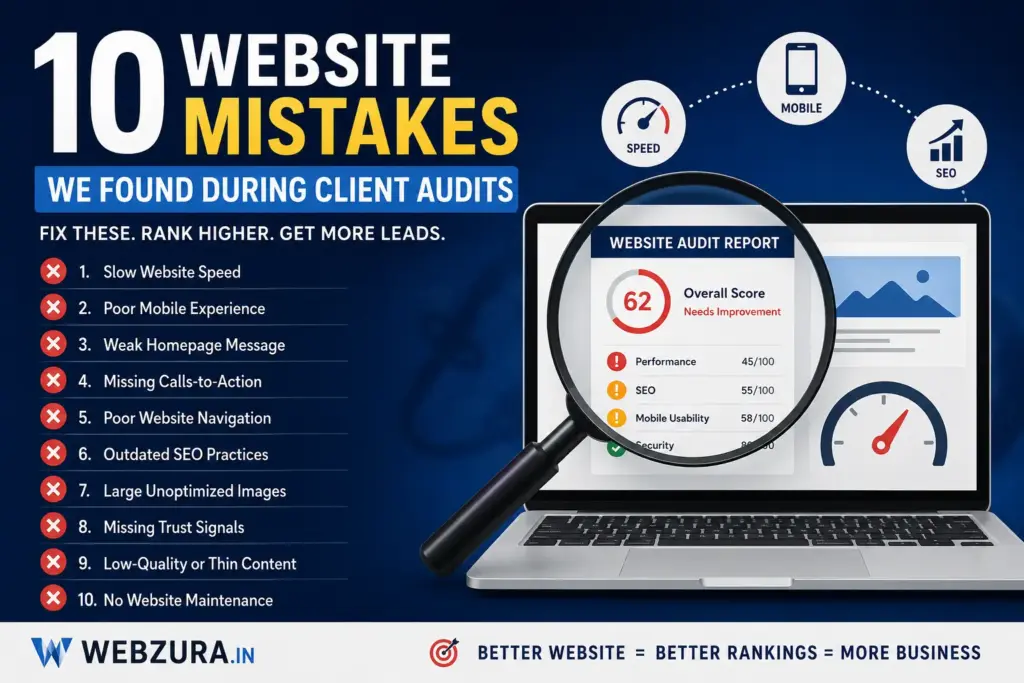
At Webzura (webzura.in), we’ve audited websites across multiple industries including local businesses, service providers, healthcare, education, retail, and startups. Surprisingly, the same mistakes appear repeatedly regardless of industry. The good news is that most of these issues can be fixed without rebuilding the entire website. In this guide, we’ll walk through the ten most common website mistakes we discover during client audits and explain practical ways to fix them so your website becomes a lead-generating asset instead of just another online brochure.
Why Website Audits Matter More Than Ever
Many business owners believe that launching a website is the finish line. In reality, it is only the beginning. Search engines change their algorithms regularly, customer expectations evolve, and technology moves forward every year. A website that performed well three years ago may now be losing visitors because it loads too slowly, lacks mobile optimization, or doesn’t clearly communicate its value.
A professional website audit uncovers hidden issues affecting SEO, user experience, and conversions. It examines everything from page speed and technical SEO to navigation, security, and content quality. Think of it like a health check-up. You might feel everything is working fine until an audit identifies problems before they become expensive. Businesses that regularly review their websites are generally better positioned to improve search visibility, user satisfaction, and lead generation.
Mistake #1 – Slow Website Loading Speed
Website speed remains one of the biggest issues found during client audits. Visitors expect pages to load almost instantly. If a page takes too long, many users simply leave before seeing your services. Studies consistently show that even a small increase in loading time can reduce conversions and increase bounce rates. Speed also plays a role in Google’s ranking systems through Core Web Vitals.
At Webzura, we often discover oversized images, unnecessary plugins, poor-quality hosting, excessive JavaScript, and missing caching as the primary causes of slow websites. The solution usually includes image optimization, browser caching, code minification, CDN implementation, and better hosting. A faster website creates a smoother user experience, improves SEO performance, and increases customer trust from the very first click.
Mistake #2 – Poor Mobile Experience
Today, most visitors browse websites using smartphones rather than desktop computers. Despite this shift, many business websites still provide an inconsistent mobile experience. Common issues include tiny fonts, buttons that are difficult to tap, overlapping content, and forms that are frustrating to complete. Since Google primarily evaluates the mobile version of your website, these problems can directly affect your rankings.
Every website audit at Webzura includes testing across multiple screen sizes and devices. Responsive layouts, optimized navigation, readable typography, and touch-friendly buttons are essential. A mobile-friendly website not only satisfies Google’s requirements but also encourages visitors to stay longer and complete inquiries or purchases.
Mistake #3 – Weak Homepage Message
Many websites greet visitors with generic headlines like “Welcome to Our Website” or “We Provide Quality Services.” Unfortunately, these statements don’t explain what the business actually does or why someone should choose it.
Your homepage has only a few seconds to answer three questions:
- What do you offer?
- Who do you help?
- Why should customers trust you?
A strong value proposition immediately communicates these answers. At Webzura, we rewrite homepage messaging to focus on customer problems and business outcomes rather than vague marketing language. Clear messaging increases engagement and encourages visitors to explore additional pages.
Mistake #4 – Missing Calls-to-Action
Even a beautifully designed website fails if visitors don’t know what to do next. During audits, we frequently find websites without clear buttons encouraging users to contact the business, request a quote, schedule a consultation, or make a purchase.
Effective CTAs should appear throughout the website—not just on the contact page. Action-oriented phrases like “Get a Free Website Audit,” “Request a Quote,” or “Book Your Consultation Today” guide visitors naturally toward conversion. Strategic CTA placement can significantly improve lead generation without increasing traffic.
Mistake #5 – Poor Website Navigation
Confusing menus are another recurring problem. Visitors should never struggle to locate your services, pricing, portfolio, or contact information.
A well-structured navigation system improves usability while helping search engines understand website hierarchy. Breadcrumbs, logical page organization, descriptive menu labels, and internal linking all contribute to a better user experience. Clean navigation also encourages visitors to explore more pages instead of leaving after viewing only one.
Mistake #6 – Outdated SEO Practices
Many websites still rely on outdated SEO methods like keyword stuffing while ignoring modern optimization techniques.
Common SEO problems discovered during audits include:
| Issue | Impact |
|---|---|
| Missing Title Tags | Lower rankings |
| Duplicate Meta Descriptions | Poor CTR |
| Missing Schema Markup | Reduced rich results |
| Broken Internal Links | Poor crawling |
| Missing XML Sitemap | Indexing issues |
| Weak Heading Structure | Lower relevance |
Modern SEO focuses on user experience, helpful content, structured data, semantic relevance, and technical optimization rather than simply repeating keywords.
Mistake #7 – Large Unoptimized Images
Images make websites visually appealing, but oversized files are among the biggest performance killers. Many websites upload images directly from cameras or design software without compression.
At Webzura, we optimize every image before publishing by compressing files, choosing modern formats such as WebP when appropriate, and adding descriptive alt text for accessibility and SEO. This simple improvement often reduces loading times dramatically while preserving visual quality.
Mistake #8 – Missing Trust Signals
People hesitate to contact businesses they don’t trust.
Common missing trust signals include:
- Customer testimonials
- Google Reviews
- SSL certificate
- Portfolio
- Client logos
- Team photos
- Business address
- Contact information
Trust signals reassure visitors that your business is genuine and experienced. Displaying reviews, certifications, awards, and completed projects builds credibility and increases conversions.
Mistake #9 – Low-Quality or Thin Content
Publishing pages with only a few sentences rarely helps users or search engines. Thin content often fails to answer customer questions or demonstrate expertise.
Helpful content should solve problems, explain services clearly, include examples, answer common questions, and naturally incorporate relevant keywords. Google’s guidance increasingly rewards content created for people rather than content written only to manipulate rankings.
Mistake #10 – No Website Maintenance
Many businesses launch a website and never update it again.
Regular maintenance includes:
- Plugin updates
- Theme updates
- Security monitoring
- Backup verification
- Broken link checks
- Speed testing
- SEO audits
- Content updates
Ignoring maintenance eventually leads to security vulnerabilities, compatibility issues, slower performance, and declining search visibility. A proactive maintenance plan protects your investment and keeps your website competitive.
How Webzura Performs Professional Website Audits
At Webzura, our audit process goes beyond simply identifying problems. We prioritize issues based on their impact on SEO, user experience, and conversions.
Our website audit typically includes:
- Technical SEO Analysis
- Core Web Vitals Testing
- Mobile Responsiveness Review
- Speed Optimization Report
- Security Assessment
- On-Page SEO Review
- User Experience Analysis
- Conversion Optimization Recommendations
- Google Business Profile Review
- Actionable Improvement Plan
Every recommendation is practical, prioritized, and tailored to your business goals rather than being a generic checklist.
Conclusion
The difference between an average website and a high-performing website often comes down to small details. Slow loading speeds, poor navigation, weak messaging, outdated SEO, and missing trust signals quietly reduce traffic and conversions every single day. The encouraging news is that these issues are usually fixable with the right strategy and ongoing maintenance.
If your website isn’t generating enough leads or ranking well on Google, a professional website audit can reveal exactly what’s holding it back. At Webzura (webzura.in), we help businesses identify hidden problems, improve website performance, strengthen SEO, and turn more visitors into paying customers.
Frequently Asked Questions
1. How often should I audit my website?
At least every 6 months, or immediately after major website updates.
2. Does website speed affect Google rankings?
Yes. Google considers page experience and Core Web Vitals among many ranking signals.
3. Can I improve SEO without redesigning my website?
Absolutely. Many SEO improvements involve technical optimization, content enhancement, and better site structure.
4. Why is mobile optimization important?
Most users browse on smartphones, and Google primarily indexes the mobile version of your website.
5. Why choose Webzura for a website audit?
Webzura combines technical SEO, WordPress expertise, speed optimization, UX improvements, and conversion-focused recommendations to help businesses achieve measurable results.